




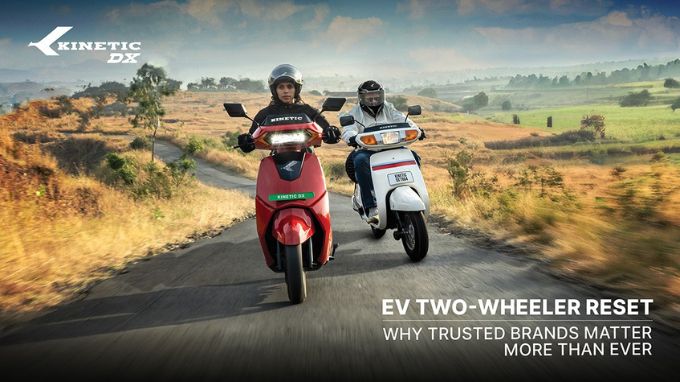
India EV Two-Wheeler Market Growth Explained
This was never just about “going electric”
For a long time, the EV conversation in India was framed as a shift toward the future, cleaner, smarter, more advanced mobility. But that framing is starting to feel incomplete.
Because if you look at actual buying behaviour today, the decision to switch to an electric two-wheeler is far less ideological and far more practical. It’s about cost efficiency, ease of use, and predictability in daily commuting. And that shift, from aspiration to utility, is quietly redefining the market.
For More Details Visit Our Website:- https://www.kineticev.in/
The era of disruption did its job. Now comes accountability.
India’s EV two-wheeler space went through a classic early-stage cycle. Rapid entry. Aggressive differentiation. Bold claims around IDC range, acceleration, and feature stacks. For a while, disruption was the story. But disruption, by itself, doesn’t build a category.
What we’re seeing now is the next phase, accountability. With evolving regulatory frameworks, tighter compliance norms, and subsidy-linked performance criteria under policies, the market is naturally filtering itself. Not every player can sustain operations at scale, especially without robust backend systems. And that’s leading to something inevitable: consolidation.
The real product isn’t the scooter. It’s the ecosystem.
One of the biggest misconceptions in the EV space is treating the vehicle as a standalone product. It isn’t. An electric two-wheeler is deeply tied to its ecosystem:
- Battery Management Systems (BMS) that govern performance and safety
- Software layers that require periodic updates
- Diagnostics infrastructure for fault detection
- Service networks for uptime assurance
When any one of these breaks down, the ownership experience suffers. We’ve already seen instances of “orphaned vehicles”, products that function technically but lack service support, spare parts availability, or brand continuity. And that’s where the real risk lies, not at the point of purchase, but in the years that follow.
Why OEM credibility is suddenly back in focus
This is where established OEMs are regaining ground. Not because they’re new to Evs, but because they’re not new to the automotive business.
Legacy players bring something that start-ups often underestimate:
- Scale in service operations
- Mature supply chain systems
- Dealer networks that extend beyond metros
For EV buyers, this translates into something very simple: certainty. Not just about how the scooter performs on Day 1, but how it holds up on Day 500. And increasingly, that’s what people are optimizing for.
For Test Ride:- https://kineticev.in/test-ride
TCO is replacing price as the real decision metric
One of the more important shifts in buyer behaviour is the move from upfront pricing to Total Cost of Ownership (TCO). Because EV economics don’t play out at the point of purchase, they play out over time.
Buyers are now factoring in:
- Battery degradation curves
- Warranty coverage on critical components
- Service turnaround times
- Availability of replacement parts
A lower sticker price can quickly lose its appeal if it leads to higher downtime or inconsistent performance. On the other hand, a well-supported product with predictable operating costs often delivers better value, even if the initial investment is higher.
The gap between claimed and real-world performance is under scrutiny
Another layer of maturity is visible in how performance claims are being interpreted. Metrics like IDC range and peak power output are still relevant, but they’re no longer taken at face value. Real-world usage introduces variables, traffic density, riding patterns, payload, and temperature conditions. These factors significantly influence actual range and battery efficiency.
As a result, buyers are moving toward brands that offer realistic performance benchmarks, not just optimistic ones. Consistency is beginning to outweigh exaggeration.
Service infrastructure is no longer a backend function
In traditional automotive conversations, service was often seen as a support function. In EVs, it’s becoming a primary differentiator. With components like BMS, controllers, and power electronics at play, the ability to diagnose and resolve issues quickly is critical. Downtime isn’t just an inconvenience; it directly impacts daily mobility. Brands that have invested in trained technicians, diagnostic tools, and distributed service networks are better positioned to deliver a reliable ownership experience. And that reliability is now influencing purchase decisions more than ever before.
This is what a maturing market looks like
The Indian EV two-wheeler market is no longer in its experimental phase.
It’s entering a phase where:
- Buyers are informed
- Claims are questioned
- Ecosystems are evaluated
Innovation still matters, but it’s no longer enough. Execution, consistency, and long-term reliability are becoming equally important.
The next phase will be defined by trust, not just technology
There’s no doubt that technology will continue to evolve, with better battery chemistry, higher energy density, and improved charging infrastructure. But none of that eliminates the need for trust. Because for most users, an electric two-wheeler isn’t a tech product. It’s a daily-use asset.
And in that context, trust is built through:
- Consistent performance
- Accessible service
- Long-term brand reliability
Not just specifications.
For Booking Click Here:- https://kineticev.in/book-now
The bottom line
India’s EV transition is no longer just about adoption. It’s about sustainable adoption. And that shift is pushing the market toward players who can deliver not just innovation, but stability. Because in the end, the brands that will lead this category forward aren’t just the ones that move fast. They’re the ones that stay.